Finished February 2026
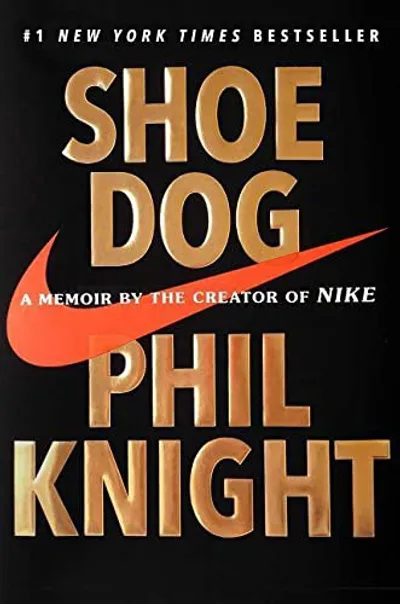
Shoe Dog
Notes published
Real businesses are messy. Nike nearly died more than once while it was growing.
What I took from it
Shoe Dog is Phil Knight’s memoir of the early years of Nike. It starts in 1962 with a young guy who has a “crazy idea” about importing Japanese running shoes, and it ends around the time the company goes public. Most of it is the bit in between, when the business was small, broke and very close to dying.
I’ve read a lot of business books that make everything sound planned. This one doesn’t. It reads like someone admitting that he mostly didn’t know what he was doing, and kept going anyway. That honesty is the main reason I liked it.
A business that was always about to run out of money
The thing that stayed with me most is cash. Knight’s company, Blue Ribbon Sports at the time, kept growing. Sales went up year after year. And they were almost always out of money.
The reason is simple once you see it. To sell more shoes, they had to order more shoes, and they had to pay for those shoes long before customers paid them. So the faster they grew, the more cash they needed upfront. Every good year made the next cash problem bigger.
Their bank didn’t like it. Knight kept asking for larger credit lines, and the bank kept telling him to slow down. At one point the bank cut them off completely. They were saved by a Japanese trading company that was willing to finance them when nobody else would.
Before this book I knew, in theory, that profit and cash are different things. Shoe Dog made it feel real. You can have customers who want your product, a team that’s working hard and numbers that keep going up, and still be a few weeks away from not being able to pay anyone.
This is something I paid a lot of attention to at elevraa. Billing, collections and cash flow aren’t exciting, but a business can be doing well and still be stuck because the money is coming in too slowly.
He kept a day job
One detail I didn’t expect: for the first several years, Knight didn’t run the company full time. He worked as an accountant and taught accounting at a university while building it on the side.
I found that reassuring. We have this picture of founders going all in from day one. Knight hedged for a long time, because he had to. The company couldn’t pay him yet. It was still very much a real business.
No plan survived
There was no master strategy in this book. There was a sequence of problems, each one handled with whatever they had at the time.
Their Japanese supplier, Onitsuka, started looking for other distributors behind their back. So Nike had to start making its own shoes, under its own brand, much earlier than planned. The name came from one of the first employees at the last minute. The logo was designed by a student Knight met at the university, for a very small fee. Bill Bowerman, Knight’s old running coach and co-founder, made an early sole by pouring rubber into his wife’s waffle iron.
None of this sounds like a company being built from a whiteboard. It sounds like jugaad. Something breaks, you find a way to make it work with what’s in front of you. I have a soft spot for that because it’s how I tend to work too. The inverter I tried to build at home as a kid came from the same place: we didn’t have one, so I tried to make one.
The misfits
The early team was strange. One of the first employees, Jeff Johnson, wrote Knight long letters about everything, and Knight barely replied. Others were former athletes, people with injuries, people nobody else would have hired. Their management meetings were loud and rude and full of people shouting at each other.
And yet they were completely committed. Knight trusted them to get on with things. He admits he was often a bad communicator and a hands-off manager, partly because he didn’t know how else to do it.
What I took from this is that a team doesn’t have to look professional to work. What matters more is whether people care about the outcome and are trusted to own their part. A lot of Nike’s early wins came from people Knight let alone.
The founder carries it
The last thing is how heavy it was. Knight writes about the stress, the debt, the lawsuits, the nights he couldn’t sleep, and the cost to his family. At one point the government hit them with a huge import duty bill that could have finished the company.
It gets sold as an inspiring founder story. To me it read more like a record of how much uncertainty one person can carry, and for how long.
What I’m taking from it
- Growth needs cash. Plan for it before the growth arrives.
- Most of building a business is reacting well to problems you didn’t see coming.
- A small team that cares will get further than a polished one that doesn’t.
- The founder is often the person absorbing all the risk. That’s worth knowing when you work with one.
The line people quote most is Knight’s advice to let everyone else call your idea crazy and just keep going. After reading the whole book, I read it less as motivation and more as a plain description of what he did. Most of the story is him not stopping at points where stopping would have made sense.