Finished August 2026
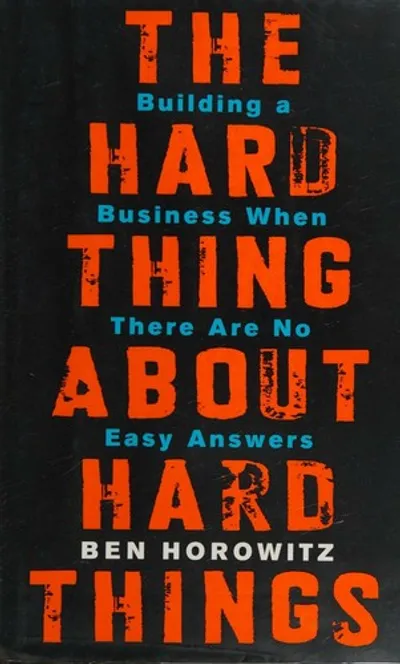
The Hard Thing About Hard Things
Notes published
The ugly side of running a company. Most of the hardest problems have no formula.
What I took from it
Ben Horowitz co-founded a company called Loudcloud during the dot-com boom, nearly lost it when the boom ended, turned it into a different company called Opsware, and eventually sold it to HP. He later co-founded a well-known venture capital firm. This book is about the years in between, when things were going badly and he was the one who had to decide what to do.
Most business books I’ve read explain how to do things well. This one is about what happens when nothing is going well and there’s no clear answer. It’s the darkest book on this list, and probably the most honest.
The Struggle
Horowitz has a name for the worst stretch of running a company: the Struggle. It’s when you started the company to build something great, and now nothing is working, you can’t tell anyone how bad it is, and quitting starts to look reasonable.
His point is that this is normal. Almost every founder goes through it. There’s no trick to avoid it. The people who get through it are the ones who keep making the next decision, even when every option is bad.
I appreciated that he doesn’t dress it up. A lot of startup content makes the hard parts sound like a phase you pass through on the way to success. He writes about it as a place where a lot of companies simply end.
That made me think about my own early ventures. Some worked, many didn’t, and for a long time I took the failures personally. Reading this, I think I was missing how normal it is for things to break.
No silver bullets
When a company is in real trouble, people look for one big move that fixes everything. A new product, a big partnership, a clever pivot. Horowitz’s view is that it almost never exists. What you usually need is a lot of unglamorous fixes, done properly, one after another. He calls them lead bullets instead of silver ones.
I like that because it matches how operations actually work. You rarely fix a business with one idea. You fix the onboarding, then the billing, then the handoffs, then the next thing.
People, products, profits
He says to take care of the people, the products and the profits, in that order. If the people leave, the other two follow them out the door.
It sounds soft written down. In the book it’s practical. He talks about making the company a good place to work so that people stay through the hard times, and about how quickly it falls apart when the best people start leaving.
Do the hard things properly
A big part of the book is about hard conversations: laying people off, firing an executive, demoting a friend, telling the team bad news.
His advice is consistent:
- Do it quickly. Waiting makes it worse for everyone.
- The person responsible should do it themselves. Don’t hand it to HR or a consultant.
- Be direct and honest about why it’s happening.
- Don’t pretend it’s good news.
He describes doing layoffs himself and how badly it can go when they’re handled with vague language. His argument is that putting it off feels kinder but mostly stretches the damage out over a longer time.
I haven’t had to do most of these. But I’ve seen how much tension builds up in a small team when something hard is left unsaid for too long.
Telling it like it is
Related to that, he argues a founder should be honest with the team about how things are going, including when they’re bad. If you only share good news, people stop believing you. If you share the problems, the people who can help actually get the chance to.
He also makes a point about information flowing upwards. A company’s leader should make it easy for bad news to reach them, because the people closest to a problem usually see it first.
Peacetime and wartime
The idea I think about most is the difference between a peacetime and a wartime leader.
In peacetime, the company has a clear advantage and the market is growing. The job is to expand, encourage creativity and let a lot of people try things.
In wartime, the company is fighting for survival. The job is to focus everything on one threat, make fast decisions and not worry too much about consensus.
Neither style is better. The problem is using the wrong one for the situation. A peacetime approach during a crisis is too slow. A wartime approach when things are fine burns people out.
I think this applies at much smaller scale too. Sometimes a business needs careful process. Sometimes it just needs someone to make a call today.
Nobody cares
One line I remember: when things go wrong, nobody cares about your excuses. Your investors, customers and employees don’t care how hard it was. They care whether you fixed it. It’s harsh, but it pulls your attention back to the problem instead of the story about the problem.
What I’m taking from it
- The hard periods are normal. Keep making the next decision.
- Look for many small fixes rather than one big one.
- People first, then product, then profit.
- Do hard things quickly, directly and yourself.
- Make it easy for bad news to reach you.
- Know whether you’re in peacetime or wartime, and act like it.
This isn’t a fun book. It’s the one I’d want to reread if I were ever running something that was going badly.