Finished May 2026
High Output Management
Notes published
A manager's output is the output of the team, so the job is to find where your time has the most leverage.
What I took from it
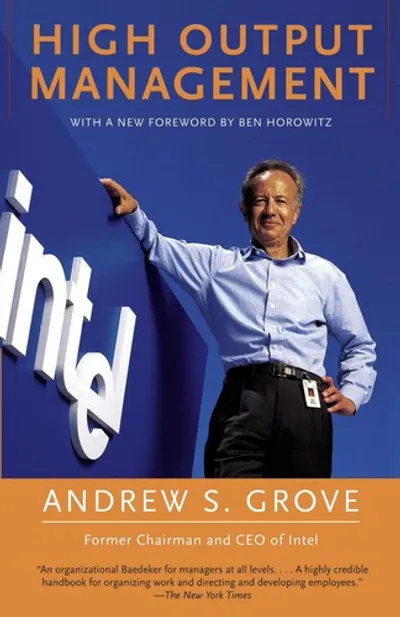
Andy Grove ran Intel for years, and High Output Management is his handbook for managers. It was first published in the 1980s, and a lot of the examples are old. The thinking isn’t.
I should be honest about why I read it. I haven’t managed a big team. Knox is small, and most of what I’ve done is set up systems so the work runs without me. I read this to understand management before I need it, so I’d have the basics in my head before I’m in the room.
What surprised me is how much of it is really an operations book. Grove was an engineer, and he treats management like a production process. That made it easy for me to get into.
The breakfast factory
The book opens with a breakfast. Grove asks you to imagine running a small kitchen that has to deliver a boiled egg, buttered toast and coffee, all hot, all at the same time, to every customer.
Then he uses it to explain basic production ideas:
- The limiting step. The egg takes longest, so everything else is scheduled around the egg. Same idea as the constraint in The Goal.
- Testing early. You want to catch a bad egg before you’ve made the toast and poured the coffee, because by then the whole breakfast is wasted. Find problems at the cheapest point.
- Leading indicators. Don’t just look at how many breakfasts you served yesterday. Look at things that predict tomorrow, like how many customers are waiting right now.
I love that he starts there. If you understand a breakfast, you understand most of what follows. A team producing work is a kind of factory too, even if the output is decisions or reports.
A manager’s output
The central idea is a definition. Grove says a manager’s output is the output of their team, plus the output of the teams they influence.
That sounds simple, but it changes what counts as work. Answering emails, attending meetings, writing reports: none of that is output by itself. It only matters if it changes what the team produces.
It also means a manager who does a lot of the work themselves, while their team waits on them, is doing their job badly even if they’re working very hard. That one landed for me. I’ve always disliked being the person everything has to wait for, and this gave me a clear reason why.
Leverage
Following from that, Grove talks about managerial leverage. Some things a manager does affect many people for a long time. Others affect one person for a day.
High-leverage examples:
- Giving one piece of information that lets a whole team make better decisions.
- Making a decision early, when it’s cheap to change, instead of late.
- Training. If you spend a few hours teaching your team something, every one of them gets better for months. Grove argues training is one of the highest-leverage things a manager can do, and that it should be done by managers, not handed off.
There’s also negative leverage. Showing up unprepared to a meeting with ten people wastes ten people’s time. Delaying a decision holds up everyone who depends on it.
Meetings are the work
I expected him to say meetings are a waste. He says the opposite. For a manager, meetings are the main medium through which the work happens. The goal is to run them well.
He splits them into two types:
- Process-oriented meetings that happen regularly: one-on-ones, staff meetings, reviews. These are about sharing information and keeping things on track.
- Mission-oriented meetings that are called to solve one specific problem or make one decision. These should have a clear purpose and end with a decision.
His view on one-on-ones stuck with me. The one-on-one belongs to the employee, not the manager. They set the agenda, they bring the problems. The manager’s job is mostly to listen and ask questions. Done regularly, it catches problems early and saves far more time than it costs.
How decisions get made
He has a simple model for group decisions that I’ve already started using in my head:
- Free discussion. Everyone gives their view, openly.
- A clear decision. Someone decides, even if not everyone agrees.
- Full support. Once it’s decided, everyone backs it, including the people who disagreed.
The failure he warns about is skipping step two. Teams keep discussing because nobody wants to make the call, and a decision never really gets made. Then people quietly do their own thing.
Task-relevant maturity
The last big idea is how closely to manage someone. Grove says it should depend on their task-relevant maturity: how experienced they are with this specific task, not how senior they are in general.
Someone new to a task needs clear, structured guidance. Someone who’s done it many times needs to be left alone, with check-ins on results. The same person can be both on the same day, on different tasks.
I find that sensible. Micromanaging an expert is a waste of both people’s time. Leaving a beginner alone is unfair to them.
Planning and OKRs
He also explains planning as taking actions today to get the output you want tomorrow, and he describes the goal-setting system Intel used, which later became known as OKRs. An objective is where you want to go. Key results are how you’ll know you’re getting there. He’s clear that it’s a tool for focus, not something to grade people on.
What I’m taking from it
- My output is what the team produces, not what I personally do.
- Find the highest-leverage use of an hour. Training is usually one.
- Catch problems at the cheapest stage.
- Watch leading indicators, not just yesterday’s results.
- Run fewer, better meetings, and make sure decisions actually get made.
- Match how closely you manage to how experienced the person is with that task.
It’s a dry book in places. But it’s the clearest explanation I’ve read of what a manager is actually supposed to produce.