Finished August 2026
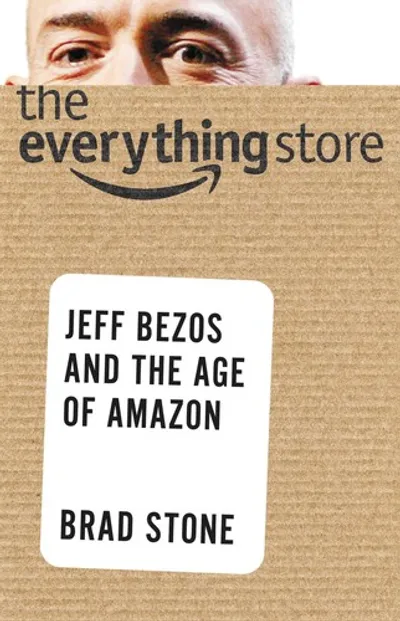
The Everything Store
Notes published
What operations look like at enormous scale: relentless focus on the customer, and systems that compound.
What I took from it
The Everything Store is Brad Stone’s history of Amazon and Jeff Bezos, from the start of the company in the mid-90s to the early 2010s. I read it after Working Backwards, which covers the same company from the inside. That was a good order. Working Backwards explains the mechanisms. This one shows the people and the pressure behind them, and it’s a lot less flattering.
I went in expecting a business biography. What I got was mostly a book about operations at a scale I can barely imagine, and about how one person’s way of thinking turned into a company’s systems.
Why start at all
The book opens with Bezos leaving a good job at a hedge fund to start an online bookstore. He explains the decision with what he called a regret minimisation framework. He imagined himself at 80, looking back, and asked which choice he’d regret more. Trying and failing wasn’t the one he’d regret. Not trying was.
I like that because it’s a practical way to make a big decision. It doesn’t remove the risk. It just makes clear which risk you’re actually more afraid of.
He also picked books on purpose. There were millions of titles, more than any physical store could stock, which made it a good first product for the internet.
The flywheel
The most famous idea in the book is the flywheel. Bezos drew it on a napkin:
- Lower prices bring more customers.
- More customers attract more sellers.
- More sellers mean more selection, which also brings more customers.
- More volume spreads fixed costs, which allows lower prices again.
Each part pushes the next one, and the whole thing speeds up over time.
What I like about it is that it describes a business as a loop instead of a list of goals. A list says “grow revenue, cut costs, improve experience”. A loop shows how each of those causes the others. If you understand the loop, you know where to push.
Long-term on purpose
Amazon spent years choosing growth and customer experience over profit. Wall Street criticised it constantly. The book shows how deliberate that was. Bezos wrote about it in his first letter to shareholders and kept repeating it.
It only worked because everyone understood the reasoning and he kept holding the line through some very bad years.
Frugality as a system
Some details I enjoyed: early Amazon desks were made from old doors on legs, because they were cheap. Employees paid for their own parking. Frugality wasn’t just a value written somewhere. It showed up in small daily decisions.
The reasoning was that constraints force creativity. If you can’t solve a problem by spending money, you have to solve it by thinking. I relate to that. A lot of what I’ve built started with not having the money to do it the normal way.
Writing instead of slides
The six-page memo shows up here too. Senior meetings start with everyone reading a written narrative in silence, then discussing it. Bezos believed slides let people hide weak thinking behind bullet points.
There’s also the ”?” email. If a customer complained to Bezos directly, he’d forward the email to the relevant manager with just a question mark. That one character meant: explain this, and fix it. The book describes how much panic those emails caused. But it also meant one customer’s experience could travel straight to the top of the company.
Small teams and internal platforms
Two more ideas I found interesting:
- Two-pizza teams. Teams small enough to be fed by two pizzas, each owning one thing end to end. Less coordination, faster decisions.
- AWS came from internal infrastructure. Amazon built tools for its own teams to stop them waiting on each other, then realised other companies had the same problem. Its own operational fix became one of its biggest businesses.
That second one stayed with me. It’s the same pattern as building an internal tool to solve your own problem, then realising other people need it too. That’s roughly how Knox Books started for me, at a much smaller scale.
The cost of it
The book doesn’t hide the downside. Bezos comes across as brilliant and also very hard to work for. There are stories of harsh feedback, impossible standards and people who burned out. The warehouses come up too, with the physical pressure on the people working in them.
I didn’t want to read only the inspiring parts. High standards built Amazon, and they also cost a lot of people a lot. I think both things are true, and anyone building systems should remember that there are people inside them.
What I’m taking from it
- Describe the business as a loop, and find where to push.
- Decide what you’re optimising for in the long run, and hold it through the bad quarters.
- Use constraints to force better thinking.
- Let a single customer complaint reach the people who can fix it.
- Internal fixes can become products.
- Systems are run by people. Design them with that in mind.